donate

Monday, April 28, 2008

...growing pains...that might leave a mark!


week in review...


this has been a week of growing pains.


all i can say is...


...ouch!


i would love to have some deep tidbit of wisdom to share.


alas, such is not the case. really, all i have is...


...ouch!


the good news is---i am still standing! thank God there is always an upside...


SELF LOVE~SELF ACCEPTANCE~SELF RESPECT

Sunday, April 20, 2008

really, really, really...that's all folks!


"you can only be destroyed by believing that you really are what the white world calls a nigger"


James Baldwin

Saturday, April 19, 2008

enough already...d@#n!

i have said it for awhile; only to be reassured that it is good to have black skin in high places. black skin is changing things from the inside ya'll. not!

vehemently i have disagreed. it is better to go unrepresented than to integrate the wickedness perpetrated against humanity.

for awhile now, i have suggested that surely the countenance of this woman must make infants cry immediately upon laying eyes on her. it seems those with whom i shared these sentiments thought that i was joking or hating. often times i was accused of hating. sipping on haterade; so here it is for you folks...

proof that she must go. it will be interesting to see if her "husband" will save her. (she isn't married...she refers to the commander in chief this way...bananas!) i doubt it seriously, he'll save himself first and cheney second. that's my bet.

if anyone has this woman's number; will you please give her a ring and ask her to take a hike? she has contributed plenty...her services will no longer be needed. please?


btw...Impeach Bush and Cheney for Torture
On Friday, George Bush told ABC News he personally approved of the approval of torture - including waterboarding - by Dick Cheney, Condoleeza Rice, Donald Rumsfeld, Colin Powell and George Tenet. http://www.democrats.com/impeach-for-torture

america is returning to her barbaric roots. i have signed on to impeach bush and cheney. i stand against this corruption and greed. i urge all that don't like the idea of being tortured to do the same. for those that think if they do nothing wrong they will be safe; may i urge you to pull your head out of the sand? there is no need for there to be proof of wrong-doing at this point.

please know that this isn't a witch hunt; though i do think rice an evil assimilated witch---with all due respect of course:-)


SELF LOVE~SELF ACCEPTANCE~ SELF RESPECT

universal declaration of human rights

so...reading about darfur and the praises of the Eleanor Roosevelt and others led me in search of the "universal declaration of human rights". this declaration has long been accepted as international law, i understand.


as such, i have reached the conclusion that law makers care not at all for breaking the law. it seems there is no hesitation nor consideration given for human life; especially when the loss is african.


these rosey words were written in 1948. they have been pretty much violated before and after they were written so they really doesn't matter now do they? kind of like the constitution and bill of rights for black americans?


or maybe america still doesn't count us in the human circle?


that's my guess.


am i looking at this all wrong? what say you?


UNIVERSAL DECLARATION OF HUMAN RIGHTS


PREAMBLE


Whereas recognition of the inherent dignity and of the equal and inalienable rights of all members of the human family is the foundation of freedom, justice and peace in the world,


Whereas disregard and contempt for human rights have resulted in barbarous acts which have outraged the conscience of mankind, and the advent of a world in which human beings shall enjoy freedom of speech and belief and freedom from fear and want has been proclaimed as the highest aspiration of the common people,


Whereas it is essential, if man is not to be compelled to have recourse, as a last resort, to rebellion against tyranny and oppression, that human rights should be protected by the rule of law,


Whereas it is essential to promote the development of friendly relations between nations,


Whereas the peoples of the United Nations have in the Charter reaffirmed their faith in fundamental human rights, in the dignity and worth of the human person and in the equal rights of men and women and have determined to promote social progress and better standards of life in larger freedom,


Whereas Member States have pledged themselves to achieve, in co-operation with the United Nations, the promotion of universal respect for and observance of human rights and fundamental freedoms,


Whereas a common understanding of these rights and freedoms is of the greatest importance for the full realization of this pledge,


Now, Therefore


THE GENERAL ASSEMBLY


proclaims THIS UNIVERSAL DECLARATION OF HUMAN RIGHTS as a common standard of achievement for all peoples and all nations, to the end that every individual and every organ of society, keeping this Declaration constantly in mind, shall strive by teaching and education to promote respect for these rights and freedoms and by progressive measures, national and international, to secure their universal and effective recognition and observance, both among the peoples of Member States themselves and among the peoples of territories under their jurisdiction.


Article 1.
All human beings are born free and equal in dignity and rights.They are endowed with reason and conscience and should act towards one another in a spirit of brotherhood.


Article 2.
Everyone is entitled to all the rights and freedoms set forth in this Declaration, without distinction of any kind, such as race, colour, sex, language, religion, political or other opinion, national or social origin, property, birth or other status. Furthermore, no distinction shall be made on the basis of the political, jurisdictional or international status of the country or territory to which a person belongs, whether it be independent, trust, non-self-governing or under any other limitation of sovereignty.


Article 3.
Everyone has the right to life, liberty and security of person.


Article 4.
No one shall be held in slavery or servitude; slavery and the slave trade shall be prohibited in all their forms.


Article 5.
No one shall be subjected to torture or to cruel, inhuman or degrading treatment or punishment.


Article 6.
Everyone has the right to recognition everywhere as a person before the law.


Article 7.
All are equal before the law and are entitled without any discrimination to equal protection of the law. All are entitled to equal protection against any discrimination in violation of this Declaration and against any incitement to such discrimination.


Article 8.
Everyone has the right to an effective remedy by the competent national tribunals for acts violating the fundamental rights granted him by the constitution or by law.


Article 9.
No one shall be subjected to arbitrary arrest, detention or exile.


Article 10.
Everyone is entitled in full equality to a fair and public hearing by an independent and impartial tribunal, in the determination of his rights and obligations and of any criminal charge against him.


Article 11.
(1) Everyone charged with a penal offence has the right to be presumed innocent until proved guilty according to law in a public trial at which he has had all the guarantees necessary for his defence.
(2) No one shall be held guilty of any penal offence on account of any act or omission which did not constitute a penal offence, under national or international law, at the time when it was committed. Nor shall a heavier penalty be imposed than the one that was applicable at the time the penal offence was committed.


Article 12.
No one shall be subjected to arbitrary interference with his privacy, family, home or correspondence, nor to attacks upon his honour and reputation. Everyone has the right to the protection of the law against such interference or attacks.


Article 13.
(1) Everyone has the right to freedom of movement and residence within the borders of each state.
(2) Everyone has the right to leave any country, including his own, and to return to his country.


Article 14.
(1) Everyone has the right to seek and to enjoy in other countries asylum from persecution.
(2) This right may not be invoked in the case of prosecutions genuinely arising from non-political crimes or from acts contrary to the purposes and principles of the United Nations.


Article 15.
(1) Everyone has the right to a nationality.
(2) No one shall be arbitrarily deprived of his nationality nor denied the right to change his nationality.


Article 16.
(1) Men and women of full age, without any limitation due to race, nationality or religion, have the right to marry and to found a family. They are entitled to equal rights as to marriage, during marriage and at its dissolution.
(2) Marriage shall be entered into only with the free and full consent of the intending spouses.
(3) The family is the natural and fundamental group unit of society and is entitled to protection by society and the State.


Article 17.
(1) Everyone has the right to own property alone as well as in association with others.
(2) No one shall be arbitrarily deprived of his property.


Article 18.
Everyone has the right to freedom of thought, conscience and religion; this right includes freedom to change his religion or belief, and freedom, either alone or in community with others and in public or private, to manifest his religion or belief in teaching, practice, worship and observance.


Article 19.
Everyone has the right to freedom of opinion and expression; this right includes freedom to hold opinions without interference and to seek, receive and impart information and ideas through any media and regardless of frontiers.


Article 20.
(1) Everyone has the right to freedom of peaceful assembly and association.
(2) No one may be compelled to belong to an association.


Article 21.
(1) Everyone has the right to take part in the government of his country, directly or through freely chosen representatives.
(2) Everyone has the right of equal access to public service in his country.
(3) The will of the people shall be the basis of the authority of government; this will shall be expressed in periodic and genuine elections which shall be by universal and equal suffrage and shall be held by secret vote or by equivalent free voting procedures.


Article 22.
Everyone, as a member of society, has the right to social security and is entitled to realization, through national effort and international co-operation and in accordance with the organization and resources of each State, of the economic, social and cultural rights indispensable for his dignity and the free development of his personality.


Article 23.
(1) Everyone has the right to work, to free choice of employment, to just and favourable conditions of work and to protection against unemployment.
(2) Everyone, without any discrimination, has the right to equal pay for equal work.
(3) Everyone who works has the right to just and favourable remuneration ensuring for himself and his family an existence worthy of human dignity, and supplemented, if necessary, by other means of social protection.
(4) Everyone has the right to form and to join trade unions for the protection of his interests.


Article 24.
Everyone has the right to rest and leisure, including reasonable limitation of working hours and periodic holidays with pay.


Article 25.
(1) Everyone has the right to a standard of living adequate for the health and well-being of himself and of his family, including food, clothing, housing and medical care and necessary social services, and the right to security in the event of unemployment, sickness, disability, widowhood, old age or other lack of livelihood in circumstances beyond his control.
(2) Motherhood and childhood are entitled to special care and assistance. All children, whether born in or out of wedlock, shall enjoy the same social protection.


Article 26.
(1) Everyone has the right to education. Education shall be free, at least in the elementary and fundamental stages. Elementary education shall be compulsory. Technical and professional education shall be made generally available and higher education shall be equally accessible to all on the basis of merit.
(2) Education shall be directed to the full development of the human personality and to the strengthening of respect for human rights and fundamental freedoms. It shall promote understanding, tolerance and friendship among all nations, racial or religious groups, and shall further the activities of the United Nations for the maintenance of peace.
(3) Parents have a prior right to choose the kind of education that shall be given to their children.


Article 27.
(1) Everyone has the right freely to participate in the cultural life of the community, to enjoy the arts and to share in scientific advancement and its benefits.
(2) Everyone has the right to the protection of the moral and material interests resulting from any scientific, literary or artistic production of which he is the author.


Article 28.
Everyone is entitled to a social and international order in which the rights and freedoms set forth in this Declaration can be fully realized.


Article 29.
(1) Everyone has duties to the community in which alone the free and full development of his personality is possible.
(2) In the exercise of his rights and freedoms, everyone shall be subject only to such limitations as are determined by law solely for the purpose of securing due recognition and respect for the rights and freedoms of others and of meeting the just requirements of morality, public order and the general welfare in a democratic society.
(3) These rights and freedoms may in no case be exercised contrary to the purposes and principles of the United Nations.


Article 30.
Nothing in this Declaration may be interpreted as implying for any State, group or person any right to engage in any activity or to perform any act aimed at the destruction of any of the rights and freedoms set forth herein.


is it possible to sue the chinese government for violations in darfur? america for her violations in america, congo, iraq, afghanistan and around the world? in this litigious society can you think of a better lawsuit?


SELF LOVE~SELF ACCEPTANCE~SELF RESPECT

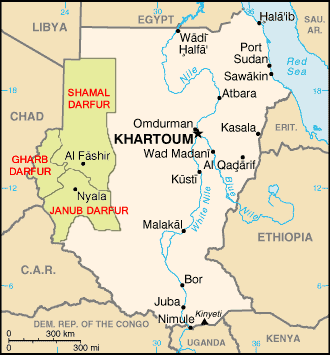
in solidarity: bringing awareness to darfur...stop the genocide now!


this is a partial cross post from Black and Missing but not Forgotten. you may check out the entire original post by going to In Solidarity: Global Day for Darfur .


i stand in solidarity. i believe when faced with evil if we sit still and quiet; we give our consent. truly injustice anywhere is a threat to justice everywhere.


each of us has a responsibility, as human beings, to do our part to make this better.


A History Lesson on Darfur:


The Darfur situation can be very confusing without a little extra information. This is what you would know if you were almost any Sudanese talking politics with your friends in an outdoor bar or at a university.


When the British left Sudan in 1956 they set it up with a small Arab minority government ruling over a mostly non-Arab African population.


The indigenous Africans had in fact already begun a revolt in 1955, the year before independence was final. The war, mostly in the south, lasted until 1972, when a peace agreement allowed limited self-government for the southern region of Sudan. A Southern Regional Assembly was established for that purpose, and it was to have control of much of the expected oil revenue from the fields just then discovered by Chevron Corporation in the south.


In 1983, after ten years of peace, Sudan’s president, Gaafar Nimeiri, nullified this agreement, disbanding the Southern Regional Assembly and imposing federal rule everywhere. New districts throughout Sudan would be ruled by military governors. The oil revenue, still unseen, would be controlled by the federal government in Khartoum.


Rebel groups quickly formed again. To make things worse, Nimeiri decreed that harsh Islamic sharia law would be imposed throughout Sudan, even over non-Muslim citizens in the south. These laws called for the amputation of hands for minor thefts, for the stoning of women, and many other cruelties. This angered the mass of people, who are quite moderate, and it angered the rebels, who now had three issues: a return to secular government, not sharia law; better representation for indigenous Africans, especially in the south; and a fair local share of the expected oil wealth, including oil jobs and more schools, roads, and clinics.


This political anger joined with the anger of hunger, as these were years of an intense African famine. An uprising in the spring of 1985 overthrew Nimeiri and caused the election of a parliamentary government led by moderate Sadiq al-Mahdi. He suspended sharia law, although it continued to be enforced by some local Arab administrators. Because of the lingering of sharia law, and because the other political issues of representation were still not fixed, the rebel groups didn’t disband.


Four nervous years followed. The oil fields could not be put into production during these years because occasional rebel attacks sent Chevron away. Sudan, sagging under heavy debt from the Nimeiri years, could not pay its loans and was cut off from further help by the International Monetary Fund. Sudan wanted to become a big oil player, but was still a poor relation among the Arab governments. So Mahdi called a new peace agreement that was expected to further subdue sharia law and perhaps reestablish selfrule in the south. That would let the oil production go forward.


Just before the conference, Mahdi was overthrown and exiled by a military strongman, General Omar Hassan Ahmad al-Bashir, who is still in power. He resumed the expansion of sharia law, shut down opposition newspapers and political parties, and imprisoned dissidents. This was a big shock to everyone. I was in high school at the time, and all of us wanted to fight it.


Under the sharia law of Bashir, a woman today cannot leave the country without the written permission of her father or husband. Men and women must sit in separate areas of public buses. The army has been purged of unbelievers. The government-attorney staffs and the courts have been cleansed of those who are not sufficiently loyal to the agenda of Bashir and his right-wing religious brotherhood. Elections have been corrupted. Men and women have been mercilessly brutalized for the most insignificant or unproved deeds. People disappear.


Bashir solved the oil field problem his own way, just as he would later solve his Darfur problem. Many Arab nomads throughout the south had been armed with automatic weapons during the two previous governments as an unsuccessful way of protecting the oil fields from rebel attacks. In the early 1990s, Bashir turned these nomads loose on the non-Arab villages, killing over two million people.


Boys who were out tending their animals far from their villages were the few survivors. They came back to find their fathers dead and their mothers and sisters raped and killed or missing into the slave trade. These boys, after incredibly difficult journeys, found their way to Ethiopia and then to other countries, including the United States, where they are still known as the Lost Boys of Sudan. So the Sudanese government is like this. Bashir is like this.


Communities in the United States, in Britain, and elsewhere in Europe accepted many thousands of these boys and helped them find new lives. This must not be forgotten by Muslims or by anyone.


Bashir built friendly relations with Osama bin Laden and other Islamic radicals, who then opened training camps in Sudan. He turned the oil fields over to the Chinese, who brought their own security people and guns into the now depopulated areas. Here was indeed a good model for economic development without sharing or resistance.


The famine must also be understood, for the weather changes seem permanent now. Beginning in the mid-1980s, nomadic Arabs and the more settled indigenous African tribesmen found themselves in greater than normal competition for the same few blades of grass for their animals, and the same few drops of water in the wells. Arabs drifted south into Zaghawa lands; some Zaghawa drifted farther south into Massalit and Fur tribal lands. This weather change has created a problem between tribes, and Bashir knows that one of his predecessors lost power because of famine. There are huge reserves of fresh water deep under Darfur. If the indigenous people can be removed, Arab farmers can be brought in and great farms can blossom. Sudan and Egypt have signed what is called “The Four Freedoms Agreement,” which effectively allows Egyptian Arabs to move into Darfur and other areas of Sudan. New farms might be a good idea if the water could be used wisely and not consumed all at once, but why not let these farms and farmers develop alongside the returned villages of my people? If the traditional people were allowed to pump this water, which they are not, these farms and this food for Sudan would result.


Throughout these recent years, the Arab government has been promoting Arab identity at the expense of Sudanese national identity. Arabs and indigenous Africans have gotten along for thousands of years in Sudan. Even in my own childhood, we feasted in one another’s tents and huts. Any disputes that couldn’t be settled through negotiations between the elders were settled in ritual battles held far from any village so that women and children and the elderly would not be harmed. In addition, there has always been so much intermarriage that it is hard to see the differences between the Arabs and the indigenous Africans. Almost every person, at least in the north half of Sudan and in most of Darfur, is Muslim, so there are no religious differences, either. But the drumbeat of Arab superiority began separating the hearts of the Arabs from their indigenous African neighbors. This should remind people of what happened in Rwanda.


Negotiations between elders to resolve tribal disputes were now harshly discouraged by the government. The Arabs were instead given weapons and military support to resolve them. While Arabs were being heavily armed by the government, non-Arab villages throughout Sudan were told to give up all their weapons or be destroyed. Darfur has been thick with automatic weapons ever since the 1980s, when Colonel Muammar Gaddafi of Libya used Darfur as a staging area for his attacks on Chad in an attempt to expand to the south. The Darfuris, both Arab and African, are good traders, and they found themselves with many of those guns. An estimated fifty thousand Kalashnikov AK-47s, RPG launchers, and M-14 rifles came into Darfur and stayed. The villagers, afraid of what was coming, would not give them up.


Darfur rebel groups bristling with this firepower started talking about Darfur independence after the latest purge of non-Arabs from government, and on April 25, 2003, thirty-three rebel Land Cruisers attacked a government military base to destroy the airplanes and helicopters that had been destroying their villages. In retaliation, President Bashir let loose the dogs of war: the green light was given to armed Arab Janjaweed militia groups. Supported by government tanks, machine-gun-mounted vehicles, additional helicopter gunships, and bombers of the Sudan Army, these Arab militias began attacking and burning indigenous villages not in a sporadic way, but in a systematic way calculated to destroy every village and kill every person. Men, women, and children were killed. Village leaders were burned alive or tortured to death in front of their friends and children. Children were tossed into fires. Wells were poisoned with the bodies of children. Everything had come into place, politically, environmentally, and culturally for a genocide in Darfur.


The non-Arab traditional Africans of Darfur are being systematically murdered and displaced by Bashir’s government of Sudan as a part of a program to remove political dissent, remove challenges to power, make way for unobstructed resource development, and turn an Arab minority into an Arab majority.


Can you do that in this century? Can you solve all your problems by killing everyone in your way? That is for the world to decide. Deciding if and when the traditional people of Darfur can go home will also decide if genocide works or not, and therefore whether it will happen elsewhere again in the world. It seems to me that this is a good place to stop it forever.


That will require the repatriation of the Darfur people who were expelled. The camps now in Chad can be moved to Darfur as new towns, bringing schools and clinics and opportunities for personal development to a number of areas that have never had them. From these new towns, village life and some new agriculture can blossom. A zone of protection can be created by the United Nations for this, just as they can be created for other people around the world who need protection in living balanced lives on the earth. In exchange for this protection, the full human rights of the men and women of these areas, the same rights so beautifully described by Eleanor Roosevelt and others in the Universal Declaration of Human Rights, must be added to the ancient customs. The Universal Declaration has long been accepted as international law.


This can be done. What is more important for the world right now than preserving ways of living in balance with the earth?


Books You can Read on Darfur:


Darfur: A Short History of a Long War
by Julie Flint and Alex de Waal


Darfur Diaries: Stories of Survival
by Jen Marlowe, Aisha Bain, and Adam Shapiro


Darfur/Darfur: Life/War
featuring photographs by U.S. Marine Brian Steidle and photojournalists Lynsey Addario, Mark Brecke, Hélène Caux, Ron Haviv, Paolo Pellegrin, Ryan Spencer Reed, and Michal Ronnen Safdie.


Genocide in Darfur: Investigating the Atrocities in the Sudan
by Samuel Totten and Eric Markusen (eds.)


They Poured Fire on Us from the Sky: The True Story of Three Lost Boys from Sudan
by Alphonsion Deng, Benson Beng, Benjamin Ajak, and Judy A. Bernstein

Voices of Sudan
by David Johnson


Organizations Dedicated to ending Genocide:


Activate through petitions, open letters, letters to all our elected officials as well as U.N., Sudanese and Chinese officials, and speaking out to the corporate sponsors of the Beijing Olympics as China plays a key role. All actions sponsored by Dream for Darfur:


1. Write to the ambassadors of the US, the UK, Russia and France to the UN. Urge them to help China insist that Khartoum stop its obstruction. Take action! Email the ambassadors.


2. Email or call the Olympic Corporate Sponsors. Send a letter to companies sponsoring the 2008 Olympics, hosted by China. (Our email system will let you do this with the touch of a button.) Take action! Send emails.


3. Pledge to turn off the commercials of Olympic Sponsors during the Games. Olympic corporate sponsors have been silent about China’s financing of the Darfur genocide, even as the sponsors are spending billions to enhance China’s image as Olympic host. If sponsors continue to ignore China’s complicity in the Darfur genocide, we will ignore their million-dollar ad campaigns. Take action! Sign the pledge.


4. Write to the UN Special Adviser on Sport for Development and Peace. Mr. Adolf Ogi represents the UN Secretary-General in contacts with international sports bodies. Tell him you are concerned that the world will gather for the Olympics while the people of Darfur are being slaughtered. Take action! Send an email.


5. Petition the International Olympic Committee. Urge the IOC to work with the international community to ensure that China uses its leverage with the government of Sudan to help stop the genocide in Darfur, and avoids tarnishing the 2008 Games in Beijing. Take action! Sign the petition.


For more information on what you can do to help, visit any of the sites above and keep checking http://blackandmissing.blogspot.com/ for more information on Darfur. Also, remember that it's never too late to participate. If you wrote something on your blog, leave a comment with your link so that others can visit your blog too. Leave any resources you have as well. Thanks for helping!


SELF LOVE~SELF ACCEPTANCE~SELF RESPECT

Tuesday, April 15, 2008

...argentina...a brief historical overview


i have been mentioning this post for awhile. despite there being so many other topics that i would like to blog on now...i must be obedient and pace myself. so here is an overview of the history of argentina. please go in search of additional information for yourself. seeking information for yourself is true education as far as i can see. study to show yourself approved...


...how many similarities, if any, to the u.s. do you see?


i always welcome your thoughts.


BLACKS IN ARGENTINA: DISAPPEARING ACTS


By HISHAM AIDI First published: April 2, 2002


When songstress Josephine Baker visited Argentina in the 1950s she asked the biracial minister of public health Ramon Carillo, "Where are the Negroes?" to which Carillo responded laughing, "There are only two— you and I."

Scholars have long pondered the "disappearance" of people of African descent from Argentina, long considered South America's "whitest" nation. A 1973 article in Ebony asked, "what happened to Argentina's involuntary immigrants, those African slaves and their mulatto descendants who once outnumbered whites five to one, and who were for 250 years 'an important element' in the total population, which is now 97 percent white?"

One history book calls the country's lack of self-identifying black people "one of the most intriguing riddles in Argentine history," while another notes that "the disappearance of the Negro from the Argentine scene has puzzled demographers far more than the vanishing Indian." Was the Afro-Argentine community annihilated by disease and war, or absorbed into the larger white community?

Of course, whiteness itself is relative. Many Argentines who proudly consider themselves white come to America and are shocked to find that in American racial discourse they are considered "Latino,""Hispanic" or vaguely "Spanish," and not white. SaysPaula Brufman, an Argentine law student and researcher, "Argentines like to think of themselves as a white nation populated by Europeans. I was surprised when in the US, people — especially Latinos — told me I was not white but Spanish."

Today in Argentina, there is a growing interest in the country's African past and Afro community, "lacomunidad Afro," as it's called. The past decade has seen black clubhouses, religious institutions and dance clubs crop up in the capital, Buenos Aires. A group called Africa Vive (Africa Lives), made up of Afro-Argentines, has spearheaded the campaign to raise awareness of the country's Afro-culture and history. At the Durban UN Conference on Racism, Africa Vive presented a widely circulated study about the socio-economic situation of Afro-Argentines. The report documented the high unemployment and difficulties with naturalization that many blacks in Argentina encounter.

"Minorities in Argentina — indigenous, Afro, etcetera— suffer from a problem of invisibility and poor organization, " says Mercedes Boschi of the Buenos Aires City's Human Rights Commission, who worked with Africa Vive on the aforementioned report, as part of the municipal government's "Right to Identity" initiative.

So, how many people in Argentina today can claim African ancestry? The numbers are themselves difficult to calculate, says Alejandro Frigerio, an anthropologist at the Universidad Catolica de Buenos Aires. "People of mixed ancestry are often not considered black in Argentina, historically, because having black ancestry was not considered proper. Today the term 'negro' is used loosely on anyone with slightly darker skin, but they can be descendants of indigenous Indians, Middle Eastern immigrants. People in Africa Vive say there are a million 'afrodescendientes' in Argentina. Although many people are not aware that they may have had a blackgreat-grandmother or -father, I think that this is an overestimation. I would estimate that there are 2 or 3 thousand Afro-Argentines, descendants of slaves, 'negros criollos,' 8 to 10 thousand in the Cape Verdean community, most born in Argentina, and I'd add another 1,200 Brazilian, Uruguayan, Cuban and African communities. "

Created in 1996, Africa Vive has reached out to Afro-Argentine leaders with the aim of creating an organization that can battle poverty in Afro-Latino communities. It has single-handedly brought media and the mainstream's attention to the plight and legacy of Afro-Argentines.

"Different groups have emerged, including Grupo Cultural Afro and SOS Racismo, but Africa Vive is probably the most important group that has rekindled interest in things African in Argentina," says Frigerio. "It is the main group composed of Afro-Argentines, descendants of the original Afro-Argentine population. Africa Vive has successfully drawn the media's attention — they organized a conference against discrimination at the University of Buenos Aires in 1999, and were written up in an eight-page article in the daily Clarin. The article was significant because for the first time in almost thirty years, the term 'Afro-Argentine community' was used, instead of 'black' community."

Frigerio continues: "Last September, these black groups, led by Africa Vive, convinced a national deputy to organize a ceremony in memory of black soldiers who died fighting for Argentina's independence. The event took place in one of the traditional halls of the National Congress and was attended by the commander-in- chief of the army and the head of state. The national deputy spoke in honor of the fallen black soldiers and then awarded honorary degrees to the heads of several black organizations. It was quite remarkable that such an event could take place in Argentina."

War heroism, in fact, is one reason Argentina lags so far behind in recognizing its people of African descent. Even after the official abolition of slavery, many blacks were still slaves and were granted manumission only by fighting in Argentina's wars, serving disproportionately in the war of independence against Spanish rule and border wars against Paraguay from 1865 to 1870. Blacks were also granted their freedom if they joined the army, but they were deliberately placed on the front line and used as cannon fodder. Historian Ysabelle Rennie notes that the government deliberately placed as many blacks as possible in "dangerous military service" and were sent into batte, "where they got killed off fighting Indians (another race Argentines were interested in exterminating. )"

Argentine sociologist Gino Germani chalks up the"disappearance" to racist immigration policies, saying that the nation's "primary and explicit objective" was to "modify substantially the composition of the population," to "Europeanize the Argentine population, produce a regeneration of races." Marvin A. Lewis, author of Afro-Argentine Discourse: Another Dimension of the Black Diaspora, concurs, saying that "there was an official, concerted effort to eliminate the blacks from Argentine society."

Many have argued that people of African descent simply "disappeared" by mingling into the waves of thousand of European immigrants. Argentine historian Mariano Bosch wrote in 1941 that Italian men had "perhaps anatavistic preference for black women: body odor led them to matrimony and the blacks accepted them as whites," or rather, "almost whites, because the Italian has much African in him, and his color is a dull pale."

"There is a silence about the participation of Afro-Argentines in the history and building of Argentina, a silence about the enslavement and poverty," adds Paula Brufman. "The denial and disdain for the Afro community shows the racism of an elite that sees Africans as undeveloped and uncivilized. ...The poverty in the Afro community was terrible. Although slavery was abolished in 1813, the death rate of freed blacks was always higher than that of white people and of slaves. Why is that? Because in Buenos Aires, slaves were very expensive, so the masters took real good care of them. Once a black got his freedom, his living standards collapsed even further."

The past few years, however, have seen a growing interest among young Argentines of all backgrounds in Afro-Argentine culture— in tango, the dance and music with such strong West African roots, and other dances such the milonga, the zamba and the malambo. For this, many thank immigrants from other parts of South America.

"Afro-Uruguayan and Afro-Brazilian migrants to Buenos Aires have been instrumental in expanding black culture — teaching Afro-Uruguayan candombe, Afro-Brazilian capoeira, orisha and secular dances to white Argentines," says Frigerio, who has written of various Afro-Argentine cultural movements, including dancing saloons owned by blacks, carnival societies and black newspapers. One such dancing saloon, "The Shimmy Club," was founded in 1922 and lasted until 1974.

Frigerio believes the newfound interest in Afro-Argentine culture is not only the result of immigration but also of a new state policy. In the 1970s and '80s, Argentina was ruled by a succession of military juntas who suppressed and almost eradicated black culture. "The military dictatorships from 1966 onwards prohibited or severely constrained the gathering of people in the street or in closed spaces— a practice which certainly negatively influenced carnivals, which almost disappeared; tango dancing,which died out until it was revitalized in the 1990s; and also black dance clubs such as The Shimmy Club. All genres of popular culture severely suffered during the dictatorships and many almost disappeared, but began resurfacing in the 1990s."

Still, he cautions against too much optimism regarding race in Argentina. "The new laws and institutes help celebrate ethnic diversity and help groups like Africa Vive emerge and operate," Frigerio says, "but they have not undermined the dominant national narrative of racial homogeneity and whiteness." While the racial situation is much better today than it was half a century ago — when a review of Josephine Baker's performance wrote of her "monkey rhythm" — Frigerio says that "today blacks are more exoticized than stigmatized. ... What scholar Livio Sansone said of Brazil, we can say of Argentina: there are hard and soft areas of racism, or areas in which it may be advantageous or disadvantageous to be black. In Buenos Aires, being black is advantageous in finding a girl/boyfriend, but less so for finding a job, unless the person is a musician or dance professor."


so let me get this straight...for lover or entertainment---it is advantageous for one to be black? well, alrighty then...


SELF LOVE~SELF ACCEPTANCE~ SELF RESPECT

Friday, April 11, 2008

open letter 4/11/2008: the horizon and the bottom line

We sincerely hope that this post can be the last Open Letter that criticizes the involvement of the NAACP and Al Sharpton in the Dunbar Village case.

Although we are not satisfied with the official conduct of the NAACP in the past few weeks, we acknowledge that the finite goals that we originally set for this campaign have been completed.

We will continue to offer our support to the victims of this crime, and would like to thank the prosecutor in this case for exercising a high degree of discretion.


Synopsis

New readers: this post is the conclusion of a protest in which thousands of African Americans from various walks of life condemned the recent actions of both the NAACP and the National Action Network in a criminal case known as the Dunbar Village Atrocity. Read details of the crime here.


Statement


We are satisfied that the NAACP will cease to use it’s power of advocacy to demand that the suspects in the Dunbar Village Atrocity case be given the opportunity to be released on bail.

We are satisfied that a long overdue show of official support for the Dunbar Village victims has been made, or is under way.

We are somewhat satisfied with the apology that was given for the public declaration that the Dunbar Village Atrocity and the Boca Raton rape case are comparable; however, it is not lost on us that the apology was done privately, and not delivered by the National office with the same level of conviction in which the original statement was made.

We condemn the NAACP’s failed attempt to obfuscate the truth concerning their participation in the press conference dated 03/11/2008.

The absurdity of their attempt to deny such easily verifiable facts caused real damage to the credibility of their establishment. Our community needs to be able to trust the integrity and veracity of any organization that purports to advocate for it, therefore, we challenge the NAACP to be honest enough to admit their mistakes in the future, even the big ones.

Conclusion


We have done our very best to be people of integrity concerning this matter, by thoroughly researching the facts before mounting this campaign.

Our wish is to be to be able to work together with justice organizations to right the wrongs inflicted on people of color, by not only enforcing standards of prosecution, but also by raising the standard of ethical conduct of all people involved.

While our demands have been met in this case, we are not convinced that either agency has taken the appropriate steps to ensure that tragic decisions like the press conference in support of the torture suspects will not be made again in the future.

We urge the NAACP and the National Action Network to interpret this protest as a golden opportunity for critical self reflection, as a new line of dialogue, and as a chance to move into better alignment with the will of the very people that they exist to serve.


The Dunbar Village Victim Assistance Fund


Individuals who would like to donate money to the victims can go to any Wachovia Bank and donate to the St. Ann’s Victim’s Assistance Fund. Donations will go directly to the mother and her son.

St. Ann’s Catholic Church will also accept donations. Checks can be made payable to the "Dunbar Village Victim Assistance Fund - St. Ann’s".

Donations can be mailed to: St. Ann’s Catholic Church, 310 N. Olive Avenue, West Palm Beach, FL 33401


For more information about this Dunbar Village Campaign, you can visit any of the following blogs:

http://www.dunbarvillage.blogspot.com/
http://adifferentstory.wordpress.com/
http://anonymissblog.blogspot.com/
http://auntjemimasrevenge.blogspot.com/
http://blackfirewhitefire.blogspot.com/
http://blackwomenvote.blogspot.com/
http://charactercorner.blogspot.com/
http://electronicvillage.blogspot.com/
http://episcopalienne.blogspot.com/
http://essentialpresence.blogspot.com/
http://focusedpurpose.blogspot.com/
http://h-essays.blogspot.com/
http://lareinacobre.blogspot.com/
http://mynewblogravenelvenlady.blogspot.com/
http://politicalseason.blogspot.com/
http://privyconcepts.blogspot.com/
http://thesowingcircle.blogspot.com/
http://tributetoblackwomen.com/news
http://web.mac.com/roslynholcomb/iWeb/Site/Blog/Blog.html
http://whataboutourdaughters.com/
http://whattamisaid.blogspot.com/
http://www.blacksapience.blogspot.com/
http://yanmommasaid.blogspot.com/
http://www.somethingwithin.com/blog
http://purplezoe.blogspot.com/


SELF LOVE~SELF ACCEPTANCE~SELF RESPECT